How to Go Beyond the Point of Decision
created with space type generator KieM.com
When we’re kids, we kick sand piles, throw rocks, and try to catch bugs- engaging with and learning about our world through movement, experimentation, and play. I believe this innate drive is the same one that eventually draws kids to play team sports. For many, participating in sports is one of the most meaningful aspects of life and a key element to cultivating a sense of belonging and value among peers. Unfortunately, the Right-wing is using state power to take away trans and non-binary people’s access to sports—yet across the country, people are fighting back.
Right now, the battle is being played out in Little v. Hecox and West Virginia v. B.P.J.–two U.S. Supreme Court cases that are shaping the future of trans athletes in public school sports. Along with the ACLU, Lambda Legal, and GSA Network, Transgender Law Center (TLC) is fighting to make sure that trans athletes in schools are able to participate in sports just like everyone else. So, when TLC reached out to us for a custom training to help them introduce Story-based Strategy (SBS) into their campaign, we said: “OF COURSE!”–Because we believe this fight is tied to a Just Transition, and more specifically to access to deep democracy, social wellbeing, and education. As Jess St. Louis (Network Practitioner) says, “It’s important to consider that, yes, these two cases are about trans athletes. But they are also trying to move trans people out of anti-discrimination law and attack funding for public schools.”
How Points of Intervention Can Orient How We Fight Back
We designed our training with TLC to hold a deeper conversation about Points of Intervention (POI), which helps groups use story to design interventions and actions. POI is an exercise to help us think about creative actions that will draw attention to a campaign. It supports groups in identifying points of intervention within a physical system (chain of production, political decision-making) or a conceptual system (ideology, cultural assumption) where action can be taken to change "the outcome" and achieve our goals. Here are the five categories of POIs we focus on:
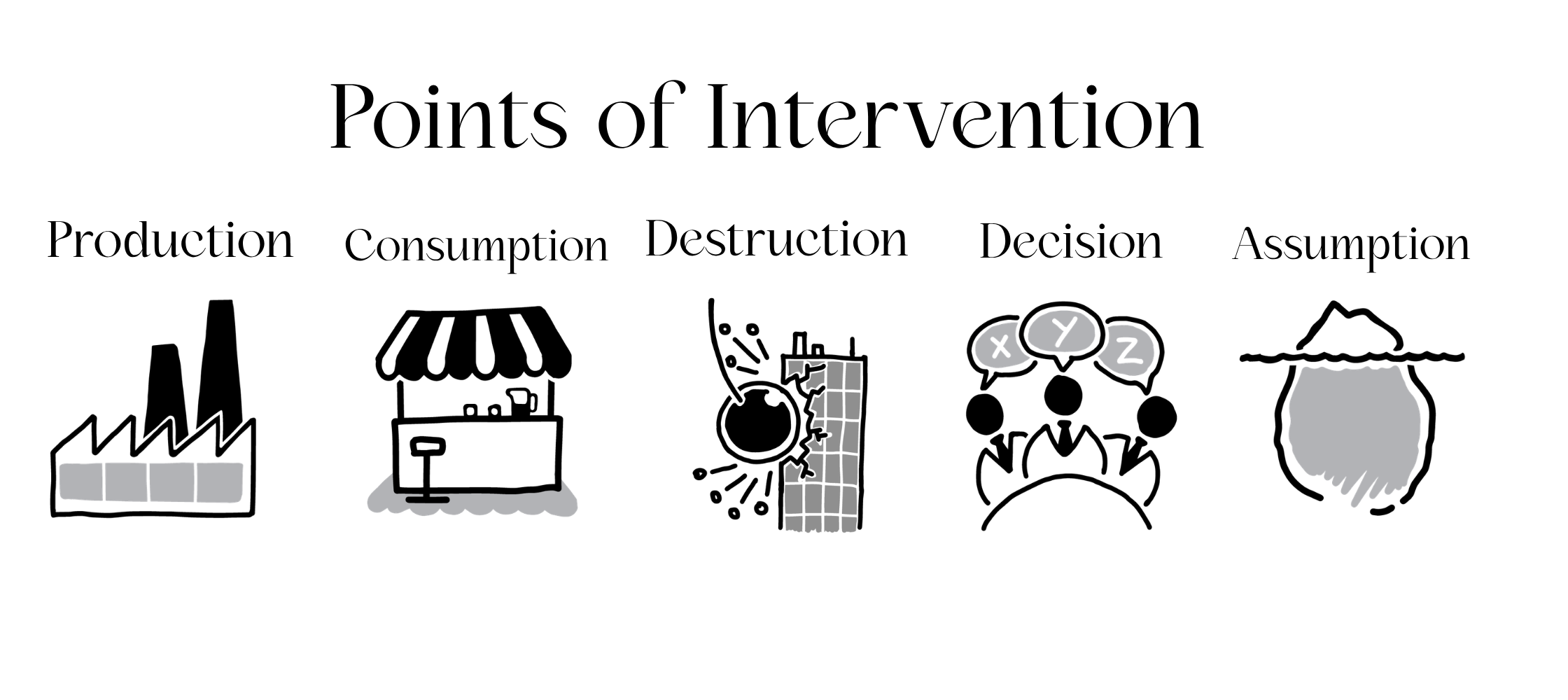
So to encourage expanded imagination and move the narrative, Jess wondered, “What could be done if we remove the point of decision as an option?” Often we tend to take action wherever there is a decision-making place, but that tends to prioritize communicating with or to our targets, when we need to communicate and move our audiences in order to build our collective power and win. Jess asks us to think about “how do we advance from where we are now, and how can we shift the narratives to create new possibilities in the future?” At a time when the federal administration and the Supreme Court are far from allyship with trans and non-binary people, there is power to be found outside of these institutions while also leveraging the case to raise visibility and build power.
How Trans folks have Moved Beyond the Point of Decision In the Past
The fight over North Carolina's House Bill 2 (HB2, often known as 'the Bathroom Bill') centered on whether the state government could override local anti-discrimination ordinances in order to prohibit trans people from using restrooms aligned with their gender identity. In response, many LGBTQAI+ activists mobilized to the streets and held spaces of resistance. We saw interventions at the point of consumption, like local businesses opening gender-nonconforming bathrooms, calls to boycott events in NC that led to Bruce Springsteen cancelling concerts, and the NCAA changing the location of the national tournament, which cost the state millions of dollars in revenue.
If you'd like to learn more about what some narrative strategists learned from the fight against HB2 in North Carolina, check out hermelinda cortés and Jess' chapter in Liberation Stories, the RadComms anthology.
In the 1970s, Sylvia Rivera and Marsha P. Johnson led the work of STAR, a collective of radical queer and trans youth who were key in providing direct action support for the Stonewall movement, the Black Panthers, and the Young Lords. But their interventions were not only in the form of direct action, but also at the point of assumption, the assumption of the nuclear family. Because of STAR, they were able to provide a home and a family to trans people in the East Village, offering the necessary care, such as shelter and safety supports.
The Riders Against Gender Exclusion (RAGE) was a volunteer-led effort to end the discriminatory use of gender markers on SEPTA transit passes in Philadelphia, which were causing harassment and unsafe conditions for transgender and gender non-conforming riders. The campaign's success was not a direct result of its high-profile protests, but rather a deliberate strategic pivot to a decentralized, community-focused intervention. This shift redefined the goal, the tactics, and the role of the people most impacted, ultimately creating the conditions for victory.
Nico Amador (Campaign Organizer) reflects:
"I realized... most of the people that we were engaging as our base were not really that excited about having to do a lot of direct action... People were showing up because they just had a desire for more community... a lot of it was about social connection and creativity."
More recently, four trans teens designed and threw the first-ever transgender youth prom outside of the U.S. Capitol in Washington DC. While intervening at the point of decision, the teens approached this POI in a surprising way, merging it with the point of assumption to reclaim this cultural rite of passage. In response to Right-wing culture warriors inserting politics into their schools, these youth brought their prom to the epicenter of national politics, creating an event where trans youth from 17 states were able to celebrate as their true selves.
created with space type generator KieM.com
Why Points of Intervention is essential to our organizing
POI is a crucial piece to Story-based Strategy. When working through SBS generally it looks something like this Cornerstone -> Battle of the Story -> Points of Intervention.
Cornerstones are where we build the strategy and clarify where and how we’ll need to build power to reach our goal; Battle of the Story is where we build a strong narrative to meet our audience and move them to action; and POI is where we bring the narrative into the world and into the perception of our audience, the story comes alive at that point, as we take action and move from the realm of theory and concept into the material world.
Why do we need creative Points of Intervention beyond the halls of state power in 2026?–Ruby Pinto (Custom Trainings Manager in Program) has an answer:
“People are feeling fed up with protests outside of county buildings, court houses and other inaccessible or unresponsive seats of power. As crises multiply, so do our opportunities to reach new people, providing narratives that make sense of what’s happening, and action steps on how to address it and what comes next. Organizers, storytellers, community leaders, educators and more have risen to meet this moment with abundant and creative strategies to protect each other, build power and nurture the connections that will build the world we deserve. This workshop is intended to create space for brainstorming around 5 distinct Points of Intervention, physical and conceptual places where we can move our narrative strategies into the world in the form of powerful action.”
What this could look like in real life
As more and more people are moved to act in solidarity with trans athletes, trans rights, and public funding for our public schools, the opportunities for interventions will increase; as will our chances to build strong relationships within our communities. Whether it's a gathering at a point of consumption like a bar to watch women’s sports and celebrate gender diversity, or organizing pick up games in your community to make space for everyone to play sports and connect - we can move outside of the opposition narrative. Instead, we can live into a story about our bodily autonomy and the urgent need to move in deep solidarity however we can, building community while doing so.
“I’ve seen people talk down the athletic abilities of trans people to rationalize our participation in sports. But recently I’ve seen people in the community talk more about building the world they wanted to live in, and part of that is playing sports! People should be able to play to win. People should be allowed to be on a competitive team, but they should also be able to participate in something that provides life skills.” -Micah from TLC
What interventions can you implement to activate your community for trans rights, and how will we ensure trans people are centered in both the process and the outcomes?
Edited by Jess St. Louis and Ruby Pinto